
The phone call we get most often from families who’ve already purchased a headstone elsewhere isn’t about a billing dispute or a delayed timeline. It’s “the stone doesn’t look the way I thought it would.” Not wrong, exactly. Just not what they pictured. The proportions are off. The text is smaller than expected. The granite color reads differently in outdoor light than it did on the screen.
That gap between expectation and reality is why the design preview conversation matters. And nowhere does it matter more than with flat markers, where the entire memorial sits below eye level and the visual relationship between text, imagery, and stone surface is everything.
A flat grave marker is a ground-level memorial piece — flush with the grass or just slightly above it, set into a concrete foundation, polished on the top face. The format is the most widely accepted shape in modern American cemeteries, permitted in sections that restrict upright monuments for maintenance reasons, and now specifically required in many newer memorial parks that use the lawn cemetery model.
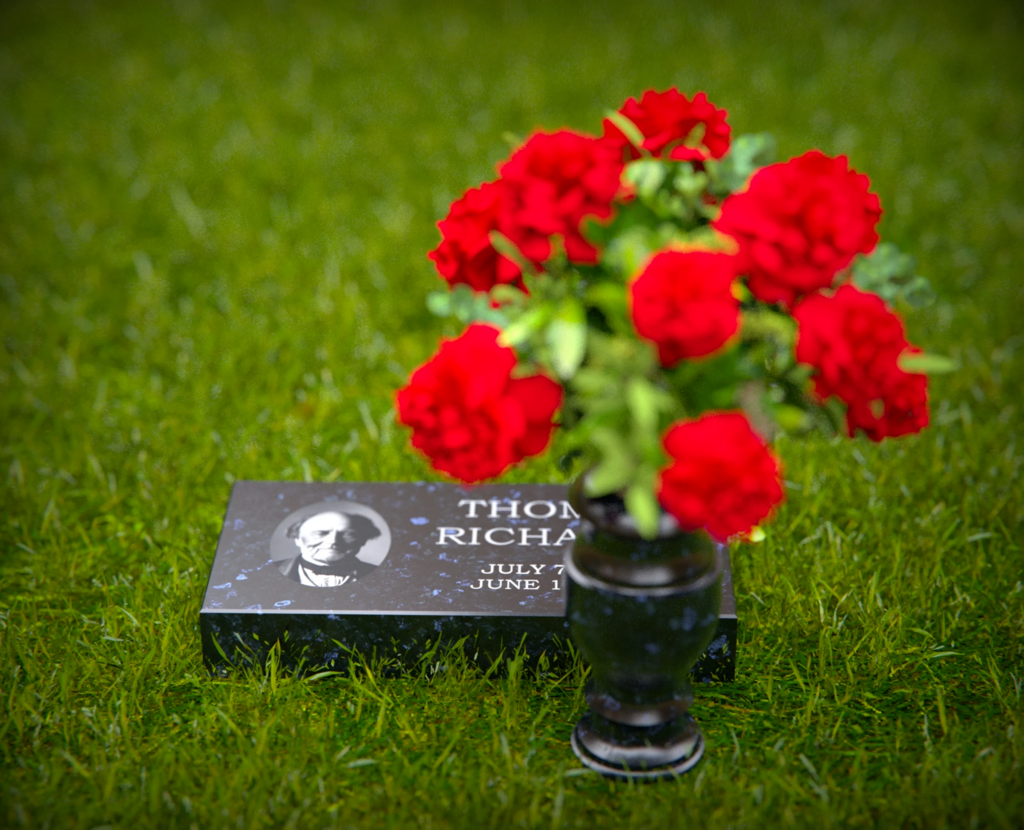
But “widely accepted” doesn’t mean simple. The flat marker decision involves more choices than most families expect going in.
Shape first. Standard rectangular formats are the obvious starting point — clean, proportional, familiar. But flat markers in heart shapes, diamond cuts, octagonal forms, and custom silhouettes are achievable in exterior-grade granite, and a number of cemeteries in California, Texas, North Carolina, and Ohio that require flush markers still permit non-rectangular shapes within specified dimensions. The shape question is partly aesthetic and partly a conversation with the specific cemetery section before any order is placed.
Material second. Flat markers in high-density granite — Indian Black, Shanxi Black, Balmoral Red, Elite Grey — hold their surface and engravability indefinitely outdoors. Granite that absorbs moisture shows it within a decade in climates with freeze-thaw cycles, which covers most of the country from Washington to Pennsylvania to Illinois. This is worth verifying before purchase: the density specification of the stone being quoted, not just the color.
Engraving depth and technique third. Flat markers in polished black granite most commonly use sandblasted engraving — mechanically precise, white-on-black contrast that reads from any angle. Portrait etchings use laser technique for finer tonal graduation. Both are achievable on a flat format. Both are visible in a 3D design preview before production begins, which is the most direct way to verify that the inscription size, the font, and the imagery proportions read the way the family expects.
The size specification should be confirmed with the cemetery before ordering, not after. Standard single flat markers run from 24×12 inches up to 28×16 or larger; companion formats for two people run wider. Cemetery sections specify maximum dimensions, and some have minimum thickness requirements. Getting this wrong creates a production delay and sometimes a complete redesign.
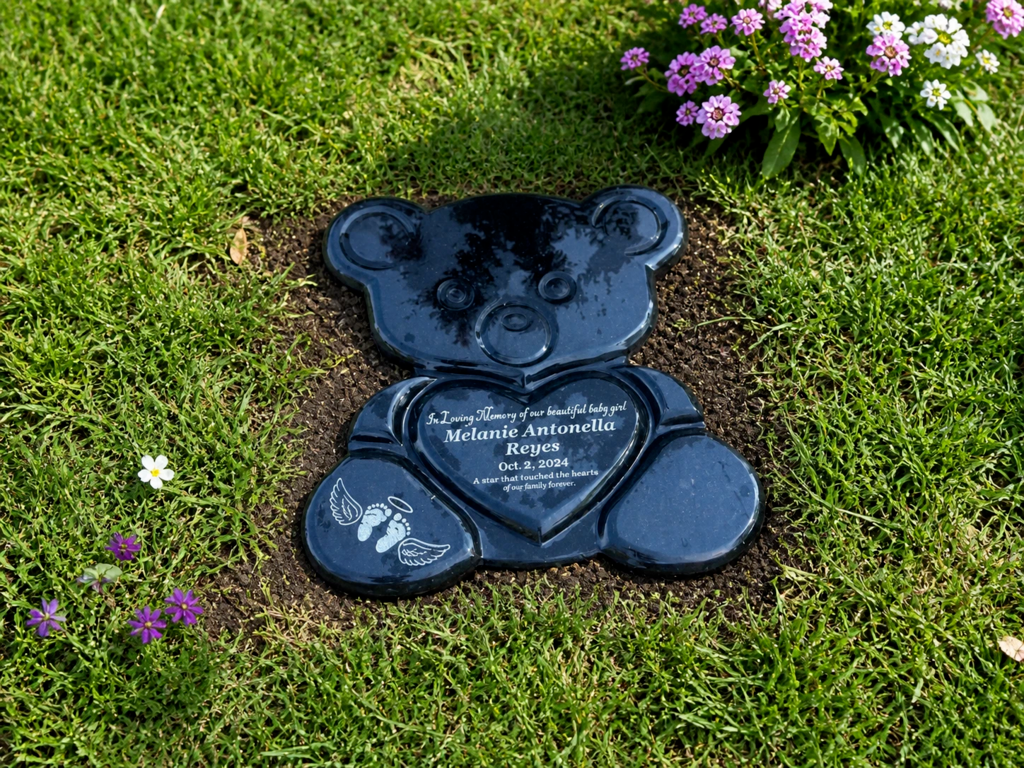
Foundation matters too. A flat marker set on improperly prepared concrete will shift, list, and eventually require a costly reinstallation. Professional foundation prep — included by manufacturers who handle full installation — uses a properly poured concrete base sized to the marker dimensions and set at the depth the cemetery specifies. Families in Oklahoma, Florida, and New Jersey who’ve tried to arrange their own installation after buying a stone elsewhere describe the foundation coordination as the step they most wish they’d had handled.
Pricing for flat granite markers starts around $1,600 for a complete piece in standard dimensions, fully inclusive of engraving, 3D design proof, nationwide delivery, and cemetery coordination. Companion flat markers for two people run slightly higher depending on size. All of this is at the lower end of the headstone price range, which is part of why flat markers are often the starting recommendation for families working with a tighter budget — though the design options at this price point are genuinely wider than most people expect when they start looking.
The current standard of quality that families should expect: a design proof rendered on the actual granite surface in 3D (not just a text layout on white background), a confirmed size that meets the cemetery’s section requirements, a density-verified stone with a lifetime guarantee, and complete installation coordination that the buyer doesn’t have to manage.
That combination — transparent pricing, full-service process, production quality — is available from manufacturers who have built around this model specifically. For families in California, Texas, Oklahoma, Pennsylvania, North Carolina, Florida, and other states where flat markers are the standard or preferred format, it’s worth comparing the total service package, not just the base price.
To understand what current flat marker designs look like, what materials perform best in different climates, and how the design process works from first proof to installation, the Remembrance Headstones team serves families across 14 showroom locations and nationwide delivery. Visit remembranceheadstones.com to browse the full flat marker catalog.
